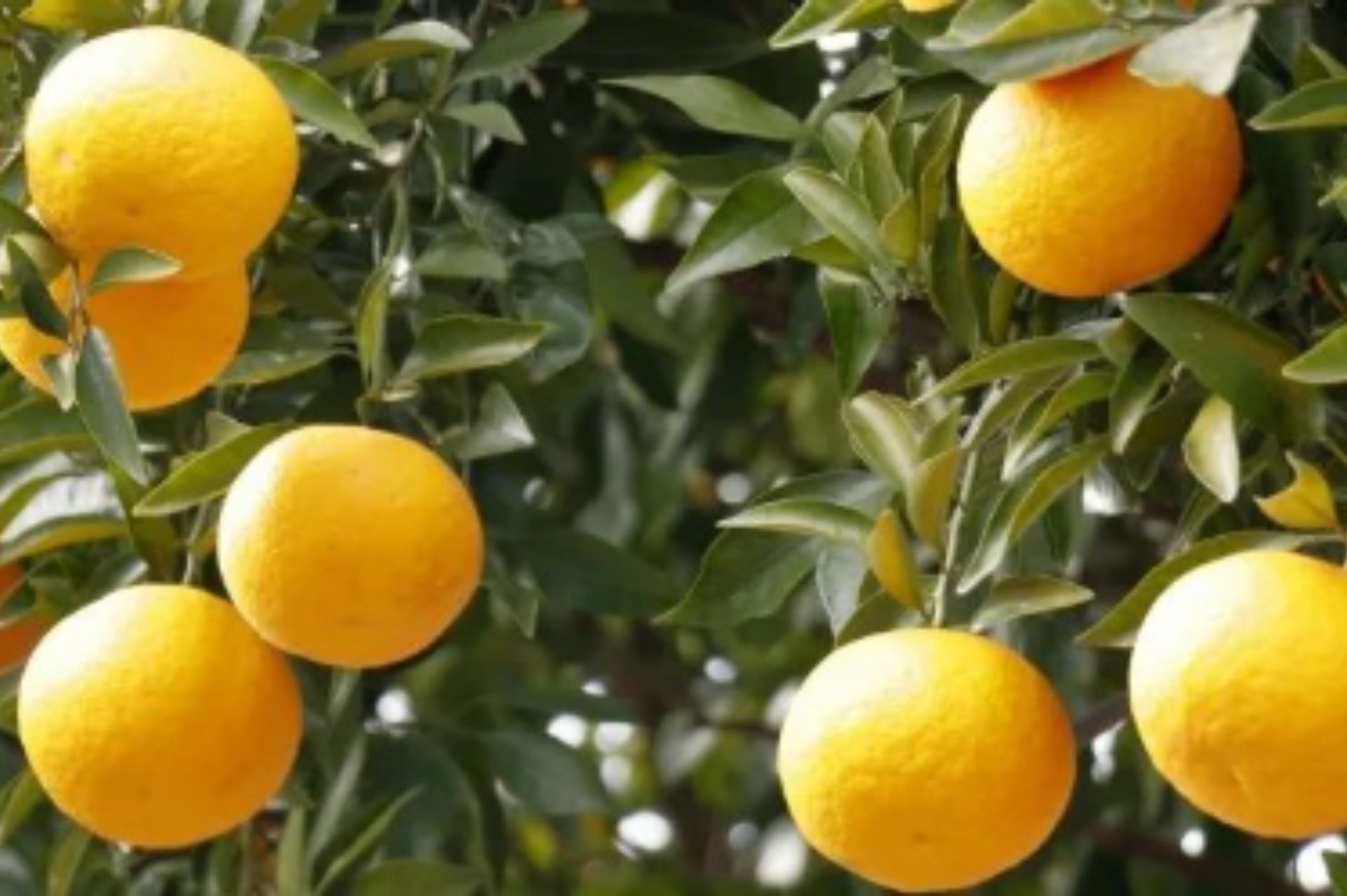
スイートオレンジ(Sweet Orange)
ラテン語学名|Citrus sinensis
主要産地|イタリア
原料分類|果実シリーズ
原料規格|500g-25kg 詳細は担当営業までお問い合わせください
抽出部位|果皮
抽出方法|冷圧搾法
植物科別|ミカン科
植物の香り|甘くフレッシュな柑橘の香り
▎エッセンシャルオイル紹介
スイートオレンジ(Sweet Orange)は、ラテン名Citrusが「レモンの香り」を意味し、一般的にオレンジと呼ばれています。非常に人気があり、果肉を食用とするだけでなく、果皮や果汁は薬用としても利用されてきました。中国の古代においても注目され、幸運や繁栄の象徴とされています。原産は中国およびインドで、その後アラブ世界を経てヨーロッパに伝わりました。当時は非常に希少で高価であり、17世紀頃になってようやく薬用として用いられるようになりました。
スイートオレンジ精油は、果皮または全果から圧搾法で抽出されるほか、果汁を搾った後の残渣から水蒸気蒸留によって抽出される場合もあります(Weiss 1997)。圧搾法で得られる精油は淡いオレンジイエローから濃いオレンジ色まであり、品種や栽培国によって色調に差が見られます。オレンジの精油は主にスイートオレンジ(Citrus sinensis)とビターオレンジ(Citrus aurantium)の2種類に分けられ、香りにも違いがあります。例として、スイートオレンジは八仙果や陳皮のような甘みのある香り、ビターオレンジはよりクラシックなオレンジ様の香りが特徴です。
▎成分解析
|主成分:モノテルペン類
その成分は産地や栽培条件により異なりますが、代表的な成分としてリモネン(Limonene)、α-ピネン(α-pinene)、β-ミルセン(β-Myrcene)が含まれます。特にオクタナール(octanal)やデカナール(Decanal)は香りに大きく影響を与えるとされています。さらに、リナロール(Linalool)、ネリルアセテート(Neryl acetate)、フロクマリン類(furanocoumarins)やケトン類(β-カルボン(carvone)、α-イオノン(α-Ionone)など)といった微量成分も含まれ、光感作性を持つ場合があります。
|成分1:リモネン(Limonene)
(1)l-リモネン(l – Limonene):L=levo(左旋)。針葉樹林の中を歩いているような印象で、典型的な柑橘の香りの中にわずかな甘さと森林のニュアンスを感じさせ、落ち着いたダイレクトな香りです。
(2)d-リモネン(d – Limonene):d=dextro(右旋)。一般的によく知られている柑橘の香りです。

▸ スイートオレンジはアセチルコリンエステラーゼ活性に関する研究があります。

▸ d-リモネン(d – Limonene)は肝機能に関する研究があります。
|成分2:ネリルアセテート(Neryl acetate)
オレンジフラワー様の香りを再現するための重要な原料であり、軽やかで上品な香りが特徴です。毒性がなく、食品香料としても使用され、一部は茶葉への香り付けや化粧品分野にも応用されています。
|原料認証
関連する認証資料を入手したい場合は、こちらをクリックして公式LINEに登録してください。@
製品仕様書 COA
GC/MS 検査報告書
輸送安全報告書
MSDS
原料製品
技術書
IFRA51 証書
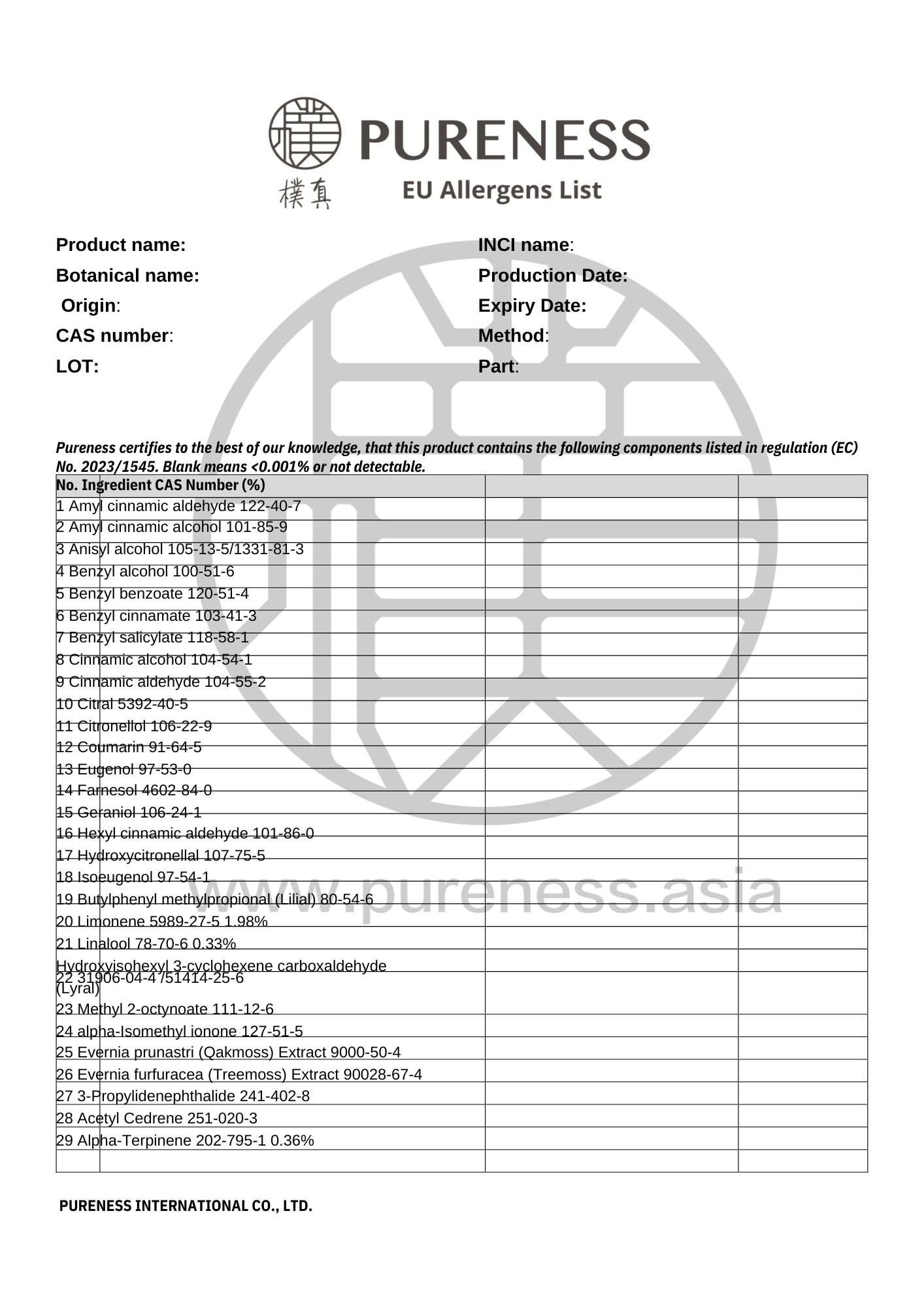
82種類のEUアレルゲン
▎参考文献
- Xiao Yu et al.d-limonene exhibits antitumor activity by inducing autophagy and apoptosis in lung cancer. Onco Targets Ther. 2018; 11: 1833–1847.
- 2.D-limonene: Safety and clinical applications. Alternative medicine review: a journal of clinical therapeutic 12(3):259-64 ·October 2007
- 3.Nancy Safwat Younis .D-Limonene mitigate myocardial injury in rats through MAPK/ERK/NF-κB pathway inhibition. Korean Journal of Physiology and Pharmacology May 2020.24(3):259-266. ·
- 4.Ana Claudia Piccinelli et al. Limonene Reduces Hyperalgesia Induced by gp120 and Cytokines by Modulation of IL-1 β and Protein Expression in Spinal Cord of Mice. Life Sci.2017 Apr 1;174:28-34.
- 5.Sheikh Bilal Ahmad et al. Antifibrotic effects of D-limonene (5(1-methyl-4-[1-methylethenyl]) cyclohexane) in CCl 4 induced liver toxicity in Wistar rats. Environmental Toxicology/Volume 33, Issue3.March 2018.Pages 361-369
- 6.Maria R,Romero-Lopez1, Perla Osorio-Diaz1, Luis A, Bello-Perez1.Fiber Concentrate from Orange (Citrus sinensis L.) Bagase: Characterization and Application as Bakery Product Ingredient. Int. J. Mol. Sci. 2011, 12(4), 2174-2186.
- 7.T. Hongratanaworakit , G. Buchbauer . Autonomic and emotional responses after transdermal absorption of sweet orange oil in humans: placebo controlled trial. International Journal of Essential Oil Therapeutics (2007) 1, 29-34.
- 8.O.I.A. Oluremi , V.O. Ojighen and E.H. Ejembi .The Nutritive Potentials of Sweet Orange (Citrus sinensis) Rind in Broiler Production . International Journal of Poultry Science 5 (7): 613-617, 2006.
- 9.S.Baylac, P.Racine. Inhibition of human leukocyte elastase by natural fragrant extracts of aromatic plants. International Journal of Aromatherapy, Volume 14, Issue 4, 2004, Pages 179-182.
- 10.Inhibition of 5-lipoxygenase by essential oils and other natural fragrant extracts. International Journal of Aromatherapy, Volume 13, Issues 2–3, 2003, Pages 138-142.
- 11.G. I. MOSS B. T. STEER P. E. KRIEDEMANN. The Regulatory Role of Inflorescence Leaves in Fruit‐setting by Sweet Orange (Citrus sinensis). Physiologia Plantarum ,Volume 27, Issue 3.
- 12.C.-F.Chau, Y.-L.Huang, C.-Y.Lin. Investigation of the cholesterol-lowering action of insoluble fibre derived from the peel of Citrus sinensis L. cv. Liucheng. Food Chemistry. Volume 87, Issue 3, September 2004, Pages 361-366.
- 13.Chi-Fai Chau, Ya-Ling Huang, Mao-Hsiang Lee. In Vitro Hypoglycemic Effects of Different Insoluble Fiber-Rich Fractions Prepared from the Peel of Citrus Sinensis L. cv. Liucheng. J. Agric. Food Chem. 2003, 51, 22, 6623-6626.
- 14.陳振義 (2010)。香草精油萃取技術及其應用。臺東區農業專訊,73,9-11。
- 15.陳妤臻 (2008)。Limonene 及柑橘果皮萃取物之抗致突變與抗菌活性評估。國家圖書館。
- 16.連培榮、孫傳家 (2009)。超臨界萃取的應用科學發展月刊,441,30-34。
- 17.吳淳美 (1987)。食品香料化學與加工。食品工業發展研究所。
- 18.D’Alessio PA. 給老鼠口服d-檸檬稀,可控制結腸炎,並且作為補充劑,可在人體內出現消炎特性.生命科學2013年7月10日;92(24-26):1151-6.
- 19.林書妍(Shu-Yen Lin); 陳右人(Iou-Zen Chan) .Structure and Health-Promoting Properties of Citrus Flavonoids. 台灣園藝期刊論文資料庫›49卷(2003)›.
|一部の画像はインターネットからのものです。著作権侵害等があった場合は、ご連絡いただければ削除いたします|