フェンネル・スィート Fennel sweet
ラテン語学名|Foeniculum vulgare
主要産地|スペイン
原料分類|香料シリーズ
原料規格|500g-25kg 詳細は担当営業までお問い合わせください
抽出部位|種子
抽出方法|蒸留
植物科別|セリ科
植物の香り|少しスパイシーで、フローラルさと草の香りを併せ持つ香り
▎エッセンシャルオイル紹介
フェンネル・スィート(Sweet Fennel)は南欧の地中海沿岸が原産で、日当たりが良く水はけの良い場所を好むセリ科の多年生植物です。環境適応能力が非常に高く、現在はヨーロッパ各国、インド、中国、北米に広く分布しています。
フェンネル・スィートの使用の歴史は古く、古代の戦士たちは勇気と力を高めるためにこれを用いていました。また、フェンネルは「約束」の象徴でもあり、結婚した二人が一生の誓いを守るという意味も込められています。薬用や料理としての歴史は古代エジプト時代まで遡り、ギリシャ人は利尿作用(排水)があることを見出し、ローマ人は胃腸の運動を助けたり、口臭を取り除いたりするために使用していました。
消化器系へのサポートに加え、フェンネル・スィートは「女性の味方」としても知られています。成分に含まれるトランス-アネトールは、女性の生理期や更年期の不調に対して優れた効果を発揮するため、インドの婦人科領域でもよく用いられています。
▎成分解析
|主成分:エーテル類
典型的なフェンネル・スィート精油の主成分は、トランス-アネトール(フェノールエーテル類)で、全体の約66%〜77%を占めています。
その他、メチルカビコール、1,8-シネオール、α-ピネン、リモネン、アニスアルコール、フェンコン、カンファー、アニス酸、フランコウマリンなど、多くの微量成分が含まれています。
|成分1:アネトール (Anethole)

▸ アニソールやプロペニルアニソールとも呼ばれ、植物性エストロゲン様作用を持つ成分です。シス型とトランス型が存在します。
|成分2:メチルカビコール (Methyl chavicol )
エストラゴール(Estragole)とも呼ばれ、タラゴン精油の主成分です。アネトールの構造異性体であり、フェニルプロペン基の二重結合の位置が異なります。効能には似た点がありますが、香りは異なります。
この成分は、タラゴン精油に約80%、トロピカルバジル精油に約85%、ラヴィンサラ精油(樹皮抽出)に約90%含まれています。
|原料認証
関連する認証資料を入手したい場合は、こちらをクリックして公式LINEに登録してください。@
製品仕様書 COA
GC/MS 検査報告書
輸送安全報告書
MSDS
原料製品
技術書
IFRA51 証書
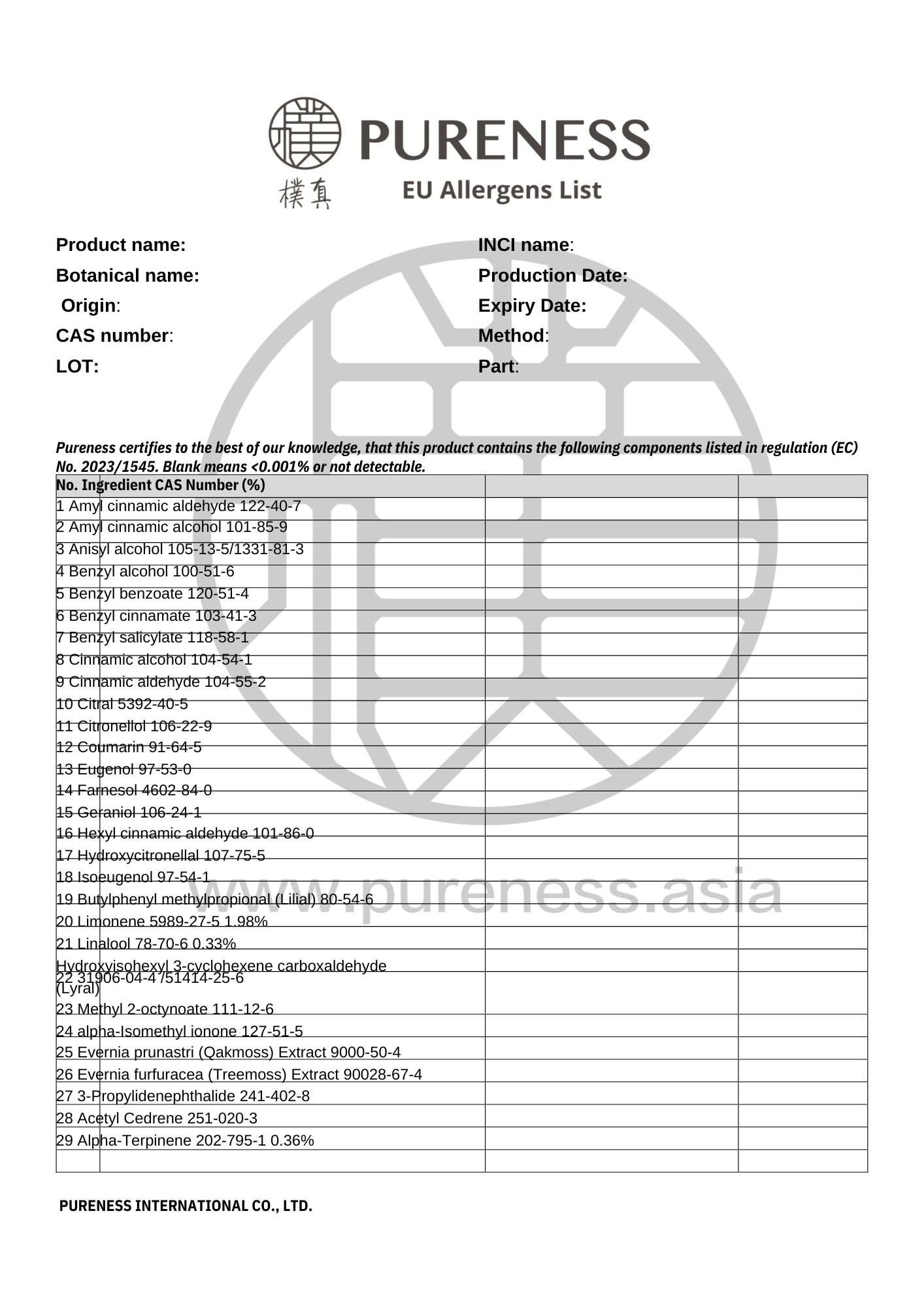
82種類のEUアレルゲン
▎参考文献
- Coelho-de-Souza AN, Lahlou S, Barreto JEF, Yum MEM, Oliveira AC, Oliveira HD, Celedônio NR, Feitosa RGF, Duarte GP, Santos CF, de Albuquerque AAC, Leal-Cardoso JH. Essential oil of Croton zehntneri and its major constituent anethole display gastroprotective effect by increasing the surface mucous layer. Fundam Clin Pharmacol. 2013;27:288-298.
- Ibrahim AM, Mohamed AS, Saleh A, Mansour AS, Mohammed AD, Mohamed AY et al. Fennel “Foeniculum vulgare” treatment protects the gastric mucosa of rats against chemically-induced histological lesions. Int J Pharmacol. 2013;9:182 -189.
- Birdane FM, Cemek M, Birdane YO, Gülçin İ, Büyükokuroğlu ME. Beneficial effects of Foeniculum vulgare on ethanol-induced acute gastric mucosal injury in rats. World J Gastroenterol. 2007;13(4):607-611.
- Dhar SK. Anti-fertility activity and hormonal profile of trans-anethole in rats. Indian J Physiol Pharmacol. 1995;39:63-67.
- Minnema DJ. 90-Day subchronic dietary toxicity study of trans-anethole in mice. 1997, CHV2595- 103. Corning Hazletone Inc. Vienna, VA.
- Oktay M, Gülcin I, Küfrevioglu O. Determination of in vitro antioxidant activity of fennel (Foeniculum vulgare) seed extracts. Lebensm Wiss Technol. 2003;36:263-271.
- Astani A, Reichling J, Schnitzler P. Screening for antiviral activities of isolated compounds from essential oils. Evid Based Complement Alternat Med. 2011;253643:1-8.
- Maruzzella J, Freundlich M. Antimicrobial substances from seeds. J Am Pharm Assoc. 1959;48:356-358.
- Veselin Marinov, Stefka Valcheva-Kuzmanova. REVIEW ON THE PHARMACOLOGICAL ACTIVITIES OF ANETHOLE. Department of Preclinical and Clinical Pharmacology, Medical University of Varna
- Bernáth, J. et al. 1998. Production-biological and structural regularities of essential oil accumulation in developing fruits of fennel (Foeniculum vulgare Mill.). Budapest: UHFI Department of Medicinal Plant Production.
- Bown, D. 1995. Encyclopedia of Herbs and Their Uses. New York: DK Publishing, Inc. 283-284.
- British Herbal Pharmacopoeia (BHP). 1996. Exeter, U.K.: British Herbal Medicine Association.
- Bruneton, J. 1995. Pharmacognosy, Phytochemistry, Medicinal Plants. Paris: Lavoisier Publishing.
- Deutsches Arzneibuch, 10th ed. (DAB 10). 1991. (With subsequent supplements through 1996.) Stuttgart: Deutscher Apotheker Verlag.
- ESCOP. 1997. 'Foeniculi aetheroleum' and 'Foeniculi fructus.' Monographs on the Medicinal Uses of Plant Drugs. Exeter, U.K.: European Scientific Cooperative on Phytotherapy.
- Europäisches Arzneibuch, 3rd ed. (Ph.Eur.3). 1997. Stuttgart: Deutscher Apotheker Verlag. 939-941.
- Grieve, M. 1979. A Modern Herbal. New York: Dover Publications, Inc.
- Karnick, C.R. 1994. Pharmacopoeial Standards of Herbal Plants, Vols. 12. Delhi: Sri Satguru Publications. Vol. 1:139141; Vol. 2:71.
- Lange, D. and U. Schippmann. 1997. Trade Survey of Medicinal Plants in GermanyA Contribution to International Plant Species Conservation. Bonn: Bundesamt für Naturschutz. 32-33.
- Leung, A.Y. and S. Foster. 1996. Encyclopedia of Common Natural Ingredients Used in Food, Drugs, and Cosmetics, 2nd ed. New York: John Wiley & Sons, Inc.
- Nadkarni, K.M. 1976. Indian Materia Medica. Bombay: Popular Prakashan. 557-559.
- Ph.Eur.3. See Europäisches Arzneibuch.
- Österreichisches Arzneibuch, Vols. 12, 1st suppl. ( AB). 1981-1983. Wien: Verlag der Österreichischen Staatsdruckerei.
- Tanira, M.O.M. et al. 1996. Pharmacological and toxicological investigations on Foeniculum vulgare dried fruit extract in experimental animals. Phytother Res 10:33-36.
- Tu, G. (ed.). 1992. Pharmacopoeia of the People's Republic of China (English Edition 1992). Beijing: Guangdong Science and Technology Press. 70.
- Wichtl, M. and N.G. Bisset (eds.). 1994. Herbal Drugs and Phytopharmaceuticals. Stuttgart: Medpharm Scientific Publishers.
|一部の画像はインターネットからのものです。著作権侵害等があった場合は、ご連絡いただければ削除いたします|